The First Seven Ecumenical Councils (325-787)
Their History and Theology
By Leo Donald Davis
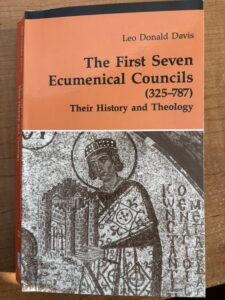 Never have I learned so much from a book I understood so little. It’s a sweeping account of 500+ years of Catholic Church history, a period that included the slow disintegration of the Roman Empire, the establishment of the Holy Roman Empire, the rise of Islam, and the never-ending struggle for power between the western empire (headquartered in Rome) and the eastern empire (headquartered in Constantinople).
The book describes events surrounding the first seven Church Councils, beginning in the year 325 with Council of Nicaea I, where the Nicene Creed was first hammered out. With surprisingly few alterations, it is still used today.
For the next 450 years, Church theologians would fight intellectually, politically, and militarily to settle disputes involving various articles of faith, particularly disagreements about the nature of Christ. These disputes were taken seriously by not only the entire clergy, but also by political leaders, armies, and everyday citizens. Some priests would literally fight to the death rather than pledge allegiance to a creed they deemed to be false; others would sign on with any creed the current emperor or local magistrate happened to endorse. Heresy after heresy sprang up, continually disrupting the unity of the church hierarchy, frequently causing schisms, politically-motivated clerical appointments, exiles, eyes being gouged out, tongues being ripped out, theologies anathematized, de-anathematized, and re-anathematized.
In short, the fine-tuning of Catholic theology was a messy business, with the prevailing orthodoxy not always determined by intellectual debate, but often by the will of an emperor, the shifting tides of political influence, and occasionally, the outright slaughter of opponents.
The complex nuances of these centuries-long theological debates are over my head, but one thing is likely to be crystal clear to any reader: the beliefs of the Catholic Church were (and continue to be) more thoroughly dissected, debated, and developed by the most brilliant of brilliant thinkers far more than any other religion or political system known to man. Anybody who dismissively calls Christianity superstition or black magic or wishful thinking needs to take a closer look at the facts, and there are plenty here in this volume.
At the same time this centuries-long effort to correctly and clearly articulate the nature of Christ was proceeding, politically-minded bishops, popes, emperors and their minions were busy trying to stack the deck so that churches and sees were led by priests sympathetic to one theological position or another, in large part so that the Councils, which were convened to reach decisions about what was true and what was heresy, would be dominated by bishops of a particular side.
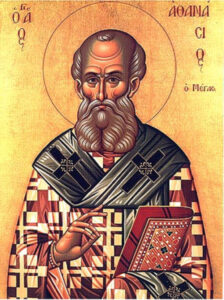
Perhaps the two most important disputes that tore the Church apart bookend these seven Councils. At Nicaea I, and long after, Arianism was the big threat to orthodox belief, a heresy that held that God the Father created the Son from nothing, thus rejecting the idea of the Trinity altogether. This heresy gained enormous traction and for a while looked like it was going to wipe out orthodox belief completely. One of the coolest guys in the book is Athanasius, the orthodox bishop of Alexandria who at one point stood virtually alone in the Church hierarchy against Arianism. Most all of his orthodox comrades had been systematically replaced, reassigned, exiled, forced into submission, or killed. He himself was exiled numerous times, but refused to cave to political pressure: his faith-filled heroism enabled the Church to hang on and outlast the Arians, whose political fortunes finally declined.
Some 450 years later, leading up to Council of Nicaea II in 787, the last of the seven covered in the book, iconoclasm was the heresy ripping the Church in half. This controversy was also related to the nature of Christ, but more indirectly. Iconoclasts believed that images of Christ or any other religious figure amounted to idolatry. Furthermore, since Christ was by nature the unknowable God, he could not be reduced to and represented by an image. The iconophils argued that images were perfectly appropriate as objects of veneration (as opposed to adoration), and served to bring people closer to God and the realities of faith. Although the Christian public was overwhelmingly in love with their sacred images, a succession of vehemently iconoclastic eastern emperors stopped at nothing, including all-out war, to wipe out icons and those who endorsed them. It was a bloody mess until Nicaea II where iconoclasm was officially condemned. Had Nicaea II gone the other way, the incredible Renaissance artwork and sculpture we see throughout Europe never would have come into existence.
What will be striking to the modern reader is how passionate people were about Christ, how seriously they took their beliefs, how willing they were to fight for them, and how brutally they did in fact fight. Compromises were reached through debate and sometime through intimidation — but the level of debate and the level of intimidation were far more intense than anything most of us “civilized” people experience or read about nowadays.
Today it’s popular to believe God can be thought of in any way that makes sense to you. This was not true in those days, when the focus was on getting it right. Having the wrong idea about the nature of Christ was bad; having the right idea about the nature of Christ was all-important.
Could it be that we no longer care what we believe?
Could it be that today we no longer have the desire to seek truth?
These are good questions to reflect on during the Advent season.
