Tragedy & Hope, by Carroll Quigley
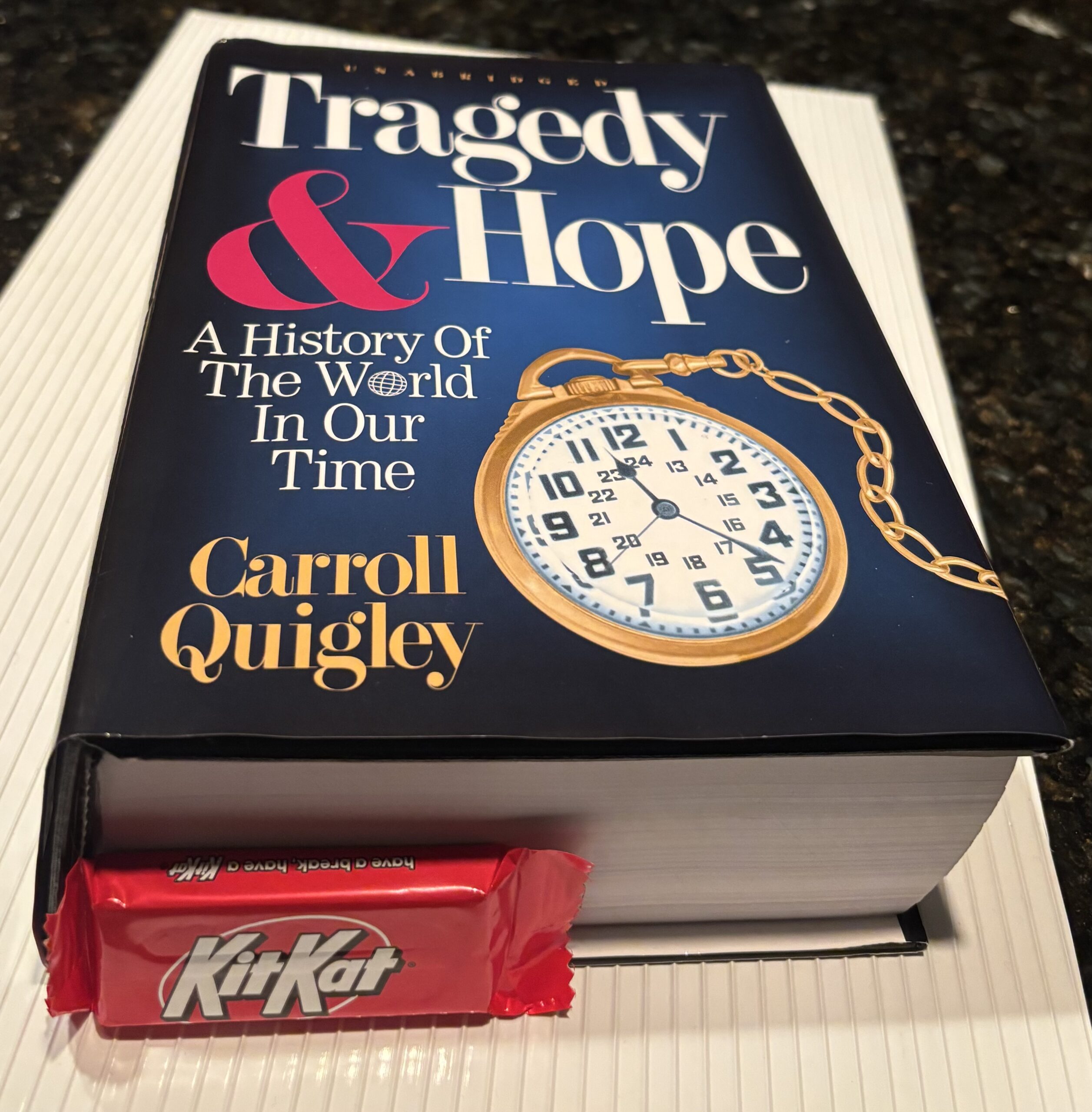 Tragedy & Hope is heavy reading, both literally and figuratively. It’s 1,311 pages of dense, detailed world history, covering events from roughly the mid-1800’s to 1965, with no graphics and only two brief footnotes. I’ve photographed the book with a Kit Kat bar for scale, to give you an idea of the size of this tome; I highly suggest you do some curls to beef up your biceps before attempting to read it.
In all seriousness, this book will bulk up your mental muscles: it is a marvelous history. Quigley (1910-1977) was an historian and professor at Georgetown, and throughout his career rubbed elbows with the ruling elites, especially in American and Great Britain, who ran the show behind the scenes. The book was suppressed upon publication, since he “named names” of many of the world’s power brokers, who, as always, preferred to remain nameless. None other than Bill Clinton was a student of Quigley’s, and was greatly inspired by him and Tragedy & Hope. I don’t know if that endorsement impresses or disgusts you, but anyone who manages to get through this volume will have a solid grasp of history, especially of the politics and culture of nations, and the political and cultural relationships among nations.
Many of the things I thought I knew about world history turn out to be wrong, and I learned several absolutely new things. Here are five examples among many hundreds:
1. I thought Hitler had built up the Nazi military machine under the radar of France and Great Britain. But in fact, Germany had strong external financial and political backing in this effort throughout the 1930’s — from Great Britain! The reason behind England’s support was its centuries-old diplomatic strategy of supporting the number two Continental power (in this case, Germany), so that the leading power would never become so dominant as to threaten Great Britain. Because Great Britain feared the power of France leading up to World War II, it backed Germany. Of course, Great Britain thought it could control Hitler: oops.
2. For years China has flooded our market with cheap consumer goods that undermine our manufacturing base and other aspects of the U.S. economy. Well, it turns out that the West (primarily Great Britain) did the same thing to China in the late 1800’s, as it opened up Asia to colonization. Chinese peasants, who could farm for only a small part of the year, eked out a living the rest of the time by selling crafts domestically. Britain, by virtue of its industrial revolution, decided to flood the Chinese market with cheap consumer goods, which in turn pushed the peasantry into extreme poverty, thus creating all the social turmoil that went along with a discouraged and angered population.
3. Quigley’s discussion of Iran in the 1940s and 1950s is interesting, especially in light of current events. Again, it was Britain (Quigley is an unabashed Anglophile. by the way, so don’t get the wrong impression) that stirred the pot. Britain controlled oil production in Iran, and by setting up the financing and operations in certain ways, managed to milk most of the profits, leaving Iran with much less than it rightfully deserved based on contractual agreements between the two nations. This capital drain kept Iran from industrializing and/or building the wealth of its citizens, leading to ever-worsening social and political upheaval we are paying the price for today.
4. I have always wondered why Latin America, which is so deeply rooted in Catholic faith and tradition, continually behaves (both culturally and politically) in the most anti-Catholic ways imaginable. Quigley has the answer: Because Iberia was under the thumb of the Moors for 700+ years, Spain and Portugal absorbed the nomadic, Arabic culture that it carries with it to this day. The Arab culture that Quigley describes is certainly the antithesis of Catholicism, particularly in its lack of interest in sacrificing personal comfort and wealth for the sake of the community (or state, or region). His lengthy discussion of this dynamic makes a world of sense out of something that I think few people understand.
5. We all know the U.S. dropped two atomic bombs on Japan at the end of World War II. What I did not know is that just prior to that, we conducted a fire-bombing raid on Tokyo which was the most destructive aerial raid in history, causing more damage than Hiroshima and Nagasaki. The raid destroyed sixteen square miles of Tokyo, killed over 40,000 people, and left a million people homeless. Yet after this raid, Japan refused to surrender. Weeks later the U.S. dropped the atomic bomb on Hiroshima — and still Japan refused to surrender. Quigley addresses the (still ongoing) debate about whether Truman made the right decision to use the atomic bombs: although many believed Japan would have been forced to surrender had we chosen to implement a naval blockade, Japanese resistance in light of the fire bombing could easily have led the Truman administration to believe Japan would fight to the last man.
As you can see from these examples, Quigley presents the big picture of historical progression, as well as the critical (and often overlooked) details of key historical events.
Towards the end of the book Quigley takes a shot at predicting how world events will unfold over the remainder of the 20th century, and he does a pretty good job. His insight that a nuclear stalemate between the U.S. and USSR will lead to smaller conflicts from minor states throughout the world (because neither superpower would risk nuclear war over comparatively minor conflicts) turned out to be spot-on. Quigley missed the impact of technological advances in computing, but in 1965, when the book was published, very few were even thinking about it.
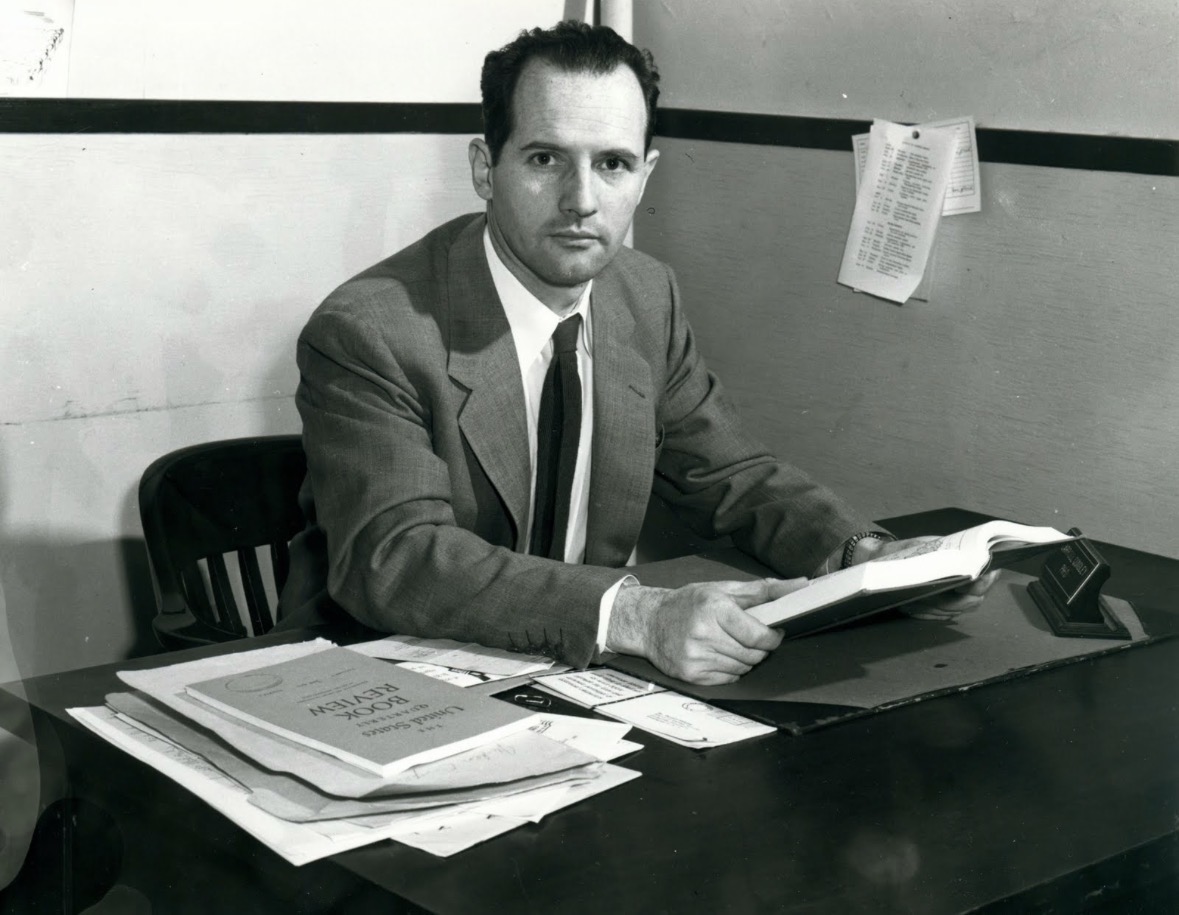
Quigley’s style, as one might guess, is complex and professorial. He is very balanced and intellectual in his criticism, condemning Hitler, Stalin, and many other “enemies” with great severity, but also treating many of “us” with great scorn whenever he thinks it is justified. The only time he goes off the rails is in his discussion of Senator Joseph McCarthy’s personality and with his conduct of the House Un-American Activities Committee (HUAC). He goes full-throttle into McCarthy Derangement Syndrome, vilifying not only McCarthy but seemingly every Republican in office from the Truman administration to 1960. He characterizes Republicans in general as being narrow, reactionary, unrealistic, prejudiced, and downright stupid … any slur he can muster. To me this attitude seems more than a bit prejudiced; I wonder if Quigley ever read Russell Kirk, for instance. At any rate, aside from his loathing for McCarthy and HUAC, Quigley maintains a lofty detachment when analyzing events across the span of more than a century.
As I read Tragedy & Hope, it seemed to me that for all Quigley’s thoroughness and vision, he had failed to adequately take into account the importance of faith in general, and of Christianity with respect to Western culture, as a determining factor in our political, social, and cultural history. I’m happy to say that Quigley does address these matters, quite effectively in my opinion, in the final pages.
It’s a remarkable book that will make you smarter — but don’t forget to work on your biceps before picking it up!
